

From Systems of Intelligence to Systems of Action
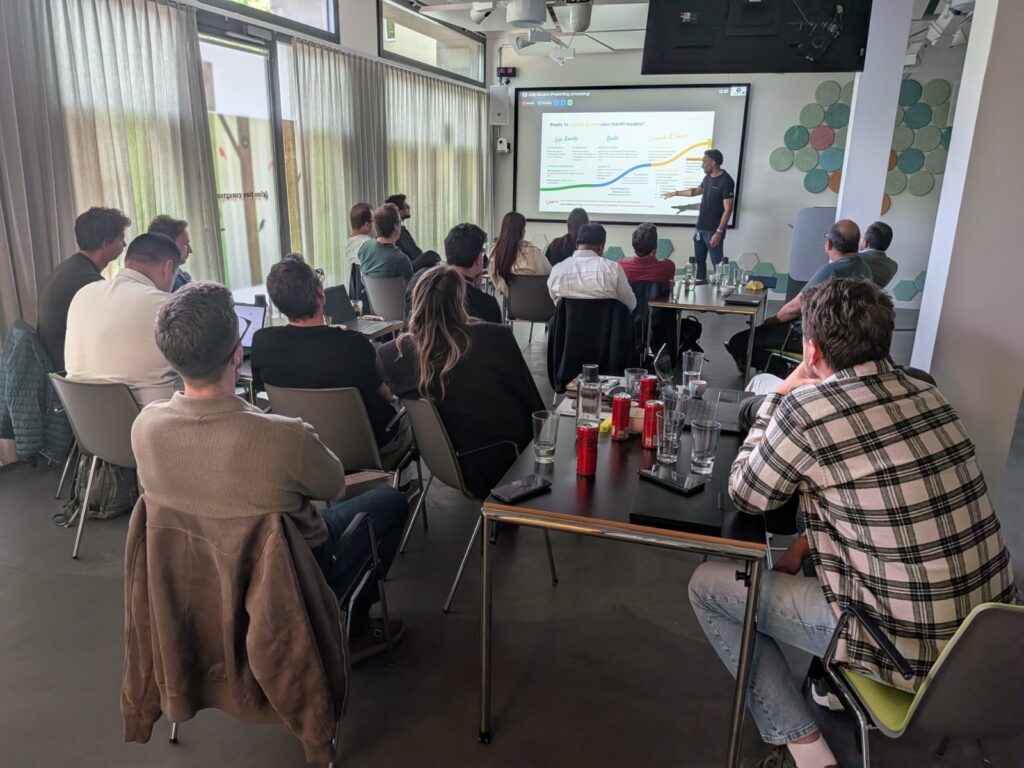
We recently joined our client for a strategic workshop at Google’s Zurich office, focused on one of the most important questions organizations are facing today: how to build an Enterprise AI Strategy that can scale beyond individual pilots and isolated use cases.
The next wave of data and AI is agentic. Organizations are gradually moving from systems that primarily provide insights toward systems of action—solutions capable of observing, reasoning, planning, collaborating, and supporting the execution of complex business activities.
However, introducing AI agents is not only a technology initiative. It requires a broader transformation of processes, data, governance models, operating structures, and ways of working.
Enterprise AI Strategy Starts with the Business Problem
One of the strongest messages from the workshop was the importance of a business-first approach.
Before selecting a platform, model, or architecture, organizations need to clearly define the business challenge they are trying to solve and determine whether the right path is to enhance an existing solution or redesign it entirely.
Enterprise AI adoption should be treated as a journey rather than a one-time project. There is a learning curve, and organizations should begin with a focused scope, test assumptions, measure results, and gradually expand. Not every initial solution will prove to be the right one, and the ability to adapt is an important part of building a sustainable AI ecosystem.
This incremental transformation approach allows companies to balance innovation with control while ensuring that each new capability delivers measurable value.
Building an Enterprise-Wide Agentic AI Framework
Together with Google specialists, we explored how Google Cloud capabilities can support the development of an enterprise-wide Agentic AI Framework.
The discussion covered different approaches to agent development, ranging from no-code and managed solutions to engineering-first frameworks. We also explored how organizations can determine when a multi-agent architecture is truly justified and when a simpler solution may provide better results.
The key question is not how many agents can be created, but whether each additional agent improves overall system performance, reliability, and business outcomes.
A scalable framework must therefore define clear criteria for agent deployment, responsibilities, decision-making authority, and collaboration. Each agent should have an identity, a clearly defined scope, and an appropriate level of autonomy.
AgentOps and Agent Governance
As organizations move from experimentation to production, managing AI agents becomes increasingly important.
AgentOps focuses on the technical and operational side of AI agents, including monitoring, performance, reliability, scalability, and cost efficiency.
Agent Governance provides the strategic layer, defining responsibilities, rules, risk controls, security requirements, and the level of human oversight required for different activities.
For each AI initiative, organizations should perform a risk assessment, classify the use case based on its complexity and potential impact, and define a clear go/no-go decision after the proof-of-concept phase.
The goal is not to limit innovation but to ensure that AI solutions can be introduced responsibly and scaled with confidence.
Data as the Foundation of Scalable AI
Another important focus area was the role of enterprise data.
AI agents can only deliver reliable results when they have access to accurate, structured, secure, and well-governed information. This requires more than connecting systems and databases. Organizations need to manage the full context behind the data.
A strong semantic layer should connect:
- Data context
- Business context
- Document context
It should explain relationships between information, standardize business logic, and enable both analytics platforms and AI solutions to interpret data consistently.
We also discussed the importance of data products, metadata management, business glossaries, lineage, and knowledge catalogs. Clear ownership is essential: while technology teams provide the infrastructure, the business should remain responsible for defining meaning, logic, and quality.
From Experimentation to a Scalable Operating Model
Successful AI transformation requires more than building a few promising prototypes.
Organizations need a structured path from experimentation to enterprise adoption:
BUILD → SCALE → GOVERN → OPTIMIZE
This includes establishing AI foundations, identifying the right initiatives, developing standardized and custom solutions, defining governance structures, monitoring performance, managing costs, and continuously improving solutions after deployment.
A balanced approach combines top-down strategic priorities with bottom-up innovation supported by a central IT function and an AI Center of Excellence.
FinOps also becomes an important part of the operating model. As AI usage grows, organizations need to understand compute costs, optimize consumption, assign ownership, and ensure that technology investments remain aligned with measurable business value.
Enterprise AI Strategy Requires More Than Technology
For our team, the workshop was an important step in validating the strategic direction of the program and exploring how automation, data, governance, and Agentic AI can be brought together into one scalable ecosystem.
The discussions reinforced a principle that continues to shape enterprise transformation initiatives: technology alone is not enough.
Sustainable value comes from combining business process expertise, automation capabilities, reliable data, governance frameworks, and cloud technologies into a cohesive Enterprise AI Strategy.
The future belongs to organizations that can move beyond isolated AI use cases and build systems that do not only generate insights, but support meaningful action.
A valuable workshop, an inspiring exchange of ideas, and another important step toward building a future-ready AI ecosystem.