
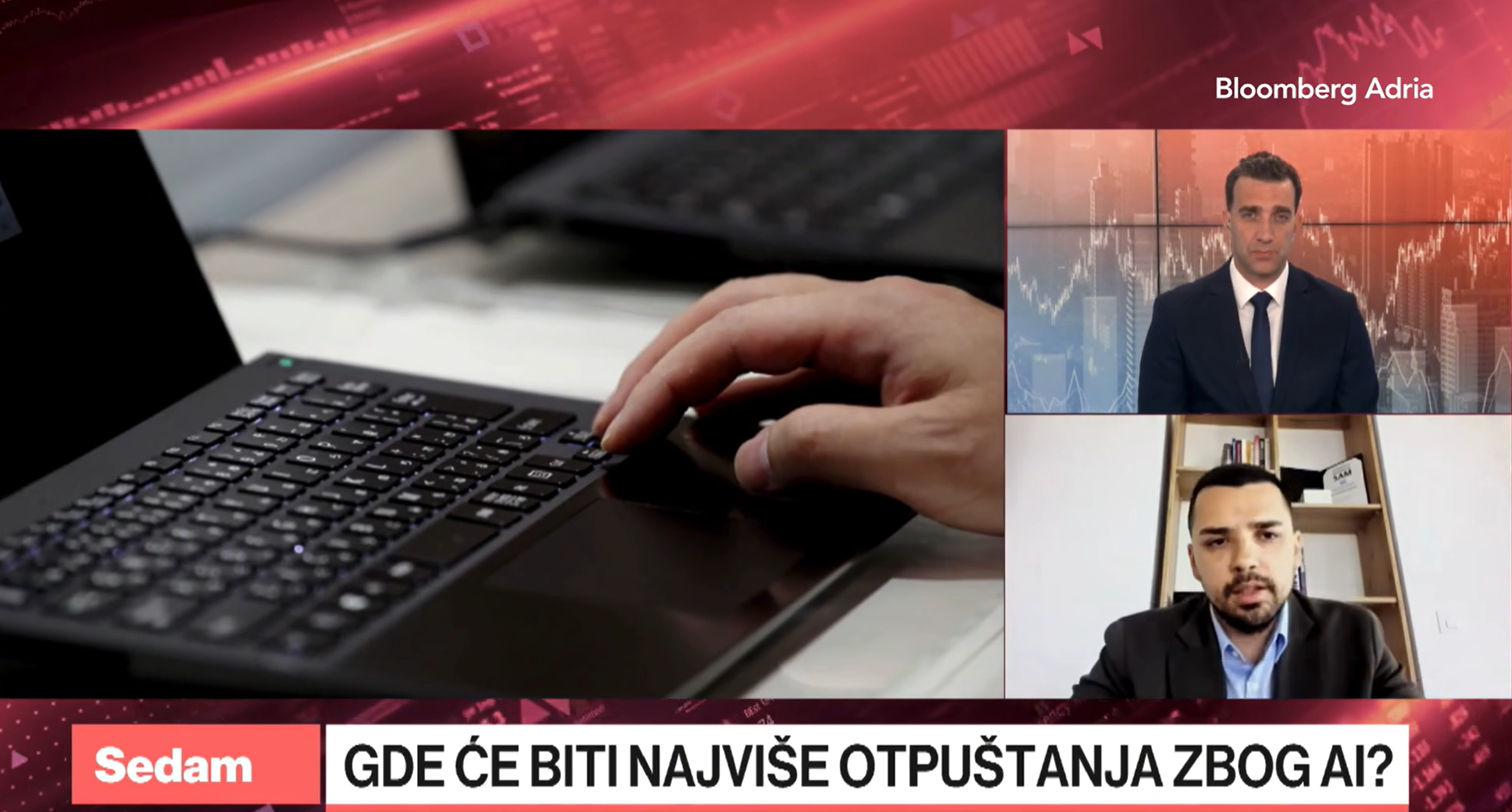
AI is changing the hiring equation and reshaping the way companies approach productivity, workforce organization, and decision-making. Our Head of Automation and Processes, Marko Pantić, recently joined Bloomberg Adria to discuss how artificial intelligence is transforming the future of work and what that means for businesses today.
What was once considered a future trend has now become a business reality. Artificial intelligence is no longer just a topic discussed at conferences or within the tech industry. Today, AI is actively transforming business operations, redefining job roles, and helping companies improve efficiency across different departments.
During the conversation on Bloomberg Adria, Marko Pantić shared insights into how companies can use AI in a practical and sustainable way, while also understanding where technology can create real business value.
AI Is No Longer a Trend
Over the past few years, companies across industries have accelerated the adoption of AI tools and automation. From customer support and administration to marketing, finance, and HR, artificial intelligence is becoming an essential part of daily business operations.
However, the key question companies are asking today is no longer whether they should use AI, but how they can use it effectively.
One of the main points highlighted during the interview was that the true value does not come from the technology itself, but from understanding where AI can improve processes, increase efficiency, and allow employees to focus on more strategic and creative tasks.
Rather than replacing people entirely, AI is changing the way teams work. Repetitive and time-consuming tasks can now be automated, giving employees more space for innovation, analysis, and decision-making.
How AI Is Changing the Hiring Equation
When discussing how AI is changing the hiring equation, it is important to understand that the impact goes far beyond automating certain tasks or reducing operational workload.
The transformation is much deeper.
Companies are now redefining the skills they look for, the structure of their teams, and the expectations they have from employees. There is a growing focus on adaptability, analytical thinking, digital literacy, and the ability to work alongside technology.
AI-powered tools enable companies to process information faster, automate administrative workflows, and improve decision-making. As a result, businesses can operate more efficiently while reducing operational complexity.
At the same time, the demand for professionals who understand how to leverage technology in their daily work continues to grow. This is why many organizations are investing heavily in employee education, digital transformation, and upskilling initiatives.
During the interview, Marko Pantić also emphasized that the future of work will belong to companies that successfully balance technology with human potential.
Automation as a Driver of Business Growth
Another important takeaway from the conversation was that automation should not be viewed as a threat to employees, but as an opportunity to improve business performance.
Many organizations still rely on manual processes that consume valuable time and resources. By implementing AI solutions and automation, companies can optimize operations and allow teams to focus on higher-value activities.
In practice, this can lead to:
- Faster information processing
- Reduced operational errors
- Improved internal communication
- Faster decision-making
- Increased productivity
- Better customer experience
Companies that recognize these opportunities early will gain a significant competitive advantage in the market.
The Future of Business With AI
The rapid development of AI technologies continues to raise important questions about the future of work, hiring, and business operations. However, one thing is becoming increasingly clear — AI will not replace companies with strong teams and clear strategies. Instead, it will help organizations work smarter, faster, and more efficiently.
The key to success is not implementing technology for the sake of innovation alone, but understanding how technology can support specific business goals and long-term growth.
During his guest appearance on Bloomberg Adria, Marko Pantić spoke about the practical side of AI transformation — how companies can approach change, identify opportunities for optimization, and build sustainable business models in the era of automation.
Thank You to Bloomberg Adria
We would like to thank Bloomberg Adria Serbia for the invitation and for the opportunity to have an insightful conversation on a topic that is becoming increasingly important for companies thinking about the future of business.
We are proud that our Head of Automation and Processes, Marko Pantić, had the opportunity to share valuable insights and practical perspectives on how AI is changing the hiring equation and shaping the future of modern business operations.
Artificial intelligence is no longer a question of the future — it is already transforming the way companies work, communicate, and grow.