
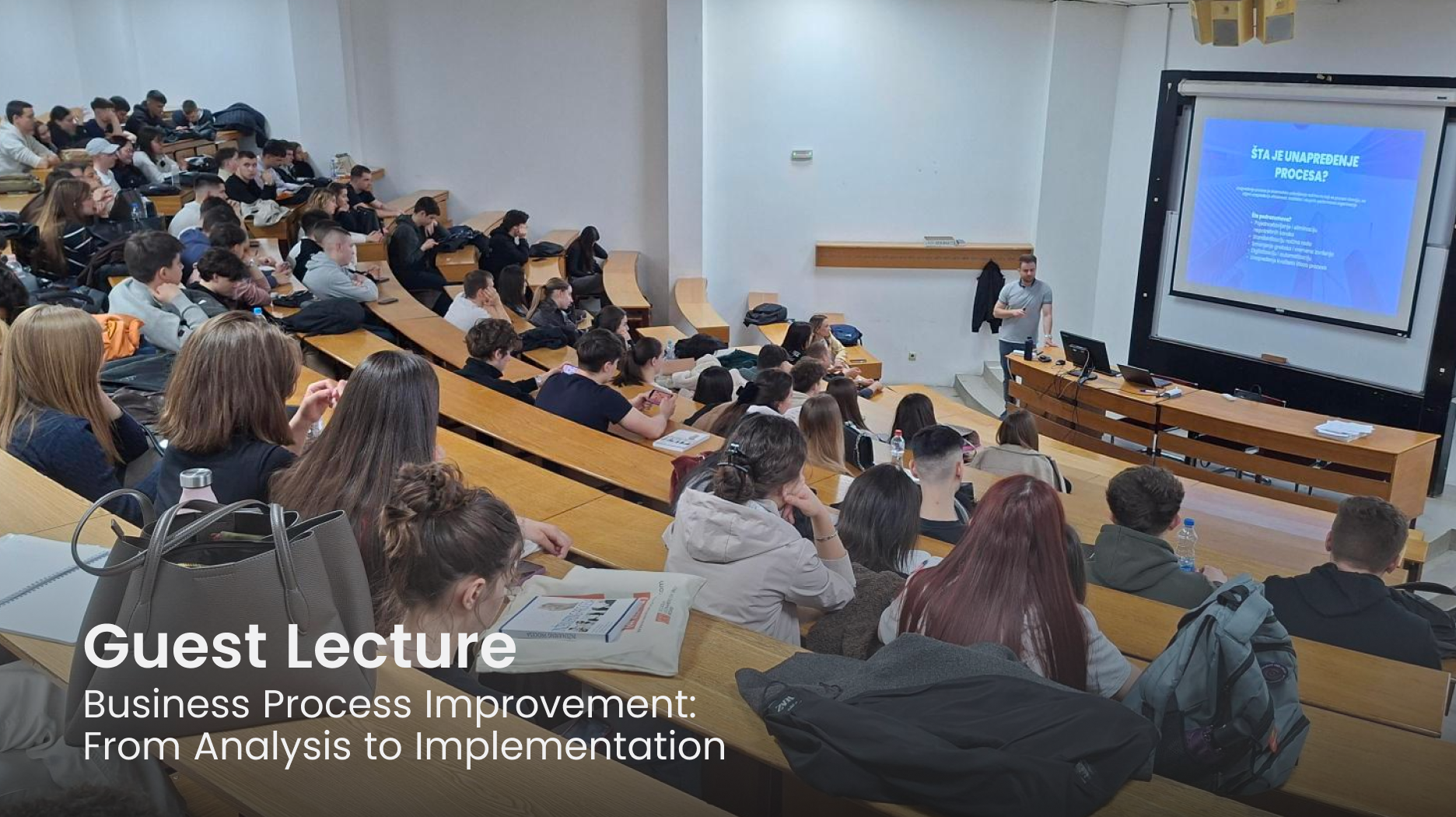
Guest lecture business process improvement was the focus of our session at the Faculty of Organizational Sciences, where we shared how we approach real projects at Simplify.
Our colleagues Michael Vučeljić and Tamara Svorcan shared what working on real projects actually looks like. We didn't go into theory. Instead, we talked about real situations. The kind where everything seems clear on paper, but once implementation starts, the real challenges begin to surface.
A big part of the conversation was about how we approach process analysis. This is where things usually go wrong. It often looks like a quick step, something teams rush through. In reality, it's the part that determines whether a project will just be delivered or actually create an impact. When analysis isn't deep enough, implementation exposes it quickly.
We also addressed AI automation, but without overselling it. AI can speed things up. It can process large volumes of data and support decision-making. But it doesn't fix a broken process. That's why, in our work, we introduce AI only when there is a clear structure and understanding of what needs to be improved. This approach aligns with broader real-world applications of AI automation in business, which are becoming increasingly common in practice.
The most valuable part of the session came from the students' questions. Direct. Practical. Honest. What happens when a team resists change? How do we deal with clients expecting faster results than what's realistic? How do we know a process is truly improved?
These are the same questions we deal with in real projects.
And that's exactly why sessions like this matter.
For us, business process improvement is not something that stays on slides. It's hands-on work. With people. With systems. With real constraints. Sometimes it moves fast. Sometimes it doesn't go as planned. But when it's done right, the results are clear and measurable.