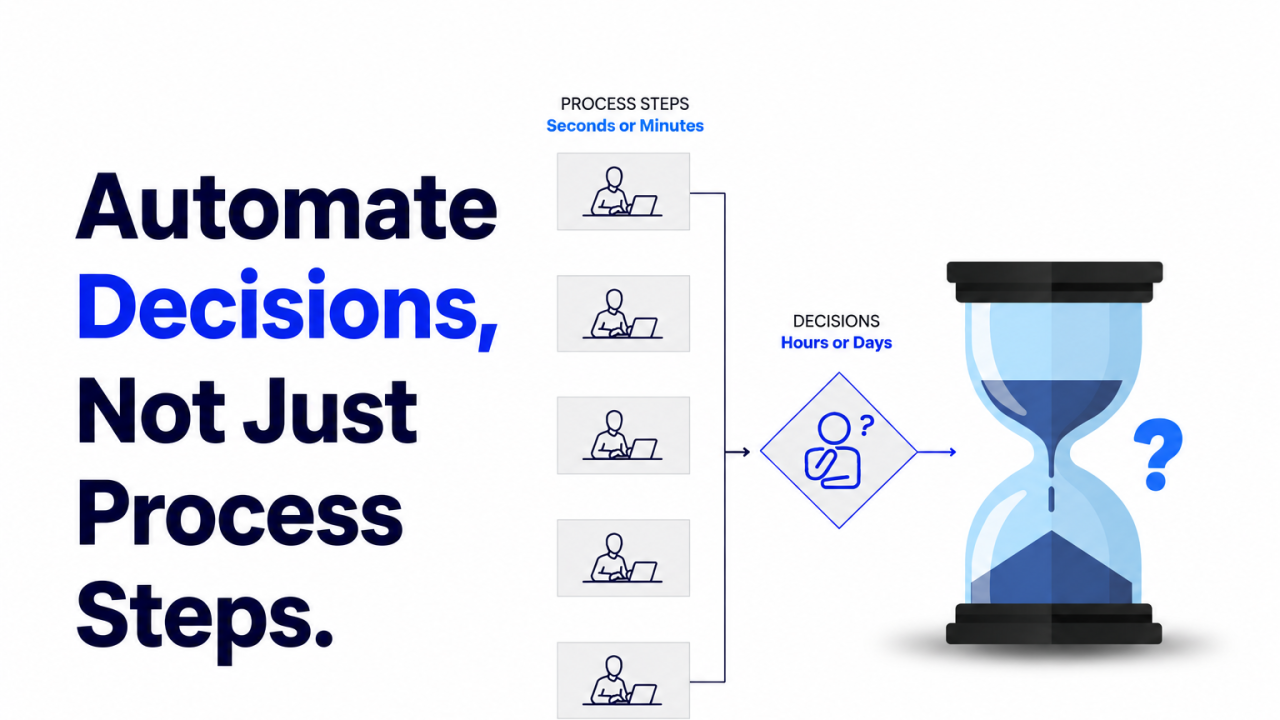
We have always treated decision making as a human centric process. It is, we believe, our greatest competitive advantage. Rarely do we sit and try to understand how we are actually making decisions. What is the process behind it?
If we structure and decompose the decision-making process, for most of our decisions we will identify patterns. Especially when it comes to business decisions.
Should we buy this? What should the price of our services be? Are we hiring an extra team member? Thousands of decisions, every day.
Our pattern in decision making can be translated into a process. If not, then we do not make decisions in a structured way. Which is a choice. Just the outcome, risk mitigation, and percentage of success is then more related to luck than to a scientific approach and deep analysis.
Sure, some of the most consequential decisions in business history were made on instinct. We should not pretend otherwise.
But most decisions are not those. They are not historic. They are not even memorable. They happen every day, dozens of times, often without us noticing.
A Columbia University study found that managers make an average of 70 decisions per day. McKinsey research goes further, managers at a typical Fortune 500 company spend 37% of their working time on decision making, and more than half of that time is spent ineffectively. The cost of that inefficiency translates to over 530,000 lost working days and roughly $250 million in wasted labor costs per year, per company. (McKinsey, Decision Making in the Age of Urgency, 2019).
Research in decision science suggests that up to 95% of recurring business decisions follow identifiable patterns. Patterns that can be modeled, designed, and automated. Because they have a clear pattern, process, data, and a decision that comes out of it.
But the first step is the elimination of ego. As Ryan Holiday writes in Ego Is the Enemy, „The ability to evaluate one’s own ability is the most important skill of all.“ When ego is not on the table. When things can happen without me clicking the yes button, then we can move to decision automation.
The first step is to identify the process itself. This is where it gets tricky. Even after decades of experience in corporate and enterprise companies, I still see that most managers and employees cannot understand or explain what a typical process is. Their job title says process owner, yet the process itself remains undefined.
Our journey in automation is usually trapped, and still misled, by use cases. People understand use cases because they relate to a familiar one. But they still do not understand process. They can identify with „we automated the payment process.“ Strange. But true. We recognize the outcome. We do not understand the mechanism. And that gap is where most automation projects quietly fail.
You can get lucky. But if we cannot explain the process by which we made a decision, which data we used, which criteria we applied, then we cannot scale it. Daniel Kahneman spent decades proving exactly this. His distinction between System 1 thinking that is fast, automatic, confident and System 2 thinking, deliberate, structured, analytical, shows that our intuitive decisions are also systematically biased. (Kahneman, Thinking Fast and Slow, 2011) Scaling that bias is not a strategy.
If we can explain the process of decision making, then we can design the decision and automate it.
There is one more thing that matters and it is often overlooked. The decision about how to automate must be made before entering the process itself. Not inside it. The starting point is finding the signal the event that actually triggers the decision. What is the input? What changes in your system, your data, or your environment that causes a decision to be needed? Once you identify the signal, you can design the decision around it. Not the other way around.
If the nature of the decision is clear structured or complex, deterministic or adaptive then the automation approach is also clear. There is no need to deploy AI where a simple rule would do the job in milliseconds. There is no need to deliver office supplies by freight truck.
What is one decision in your organization that you could design today?
(c) 2025 Simplify. All Rights Reserved | Privacy Policy | Terms of Use