We have always viewed decision-making as a human-centered process. We believe that this is one of our biggest competitive advantages. However, we rarely stop to understand how we actually make decisions and the process behind them.
When we analyze the decision-making process, we can recognize clear patterns in most business activities. Should we buy a specific product? How to form the price of the service? Is it time to hire a new team member? Thousands of similar decisions are made every day.
If the decision-making process can be described and documented, it can be turned into a process. Otherwise, results often rely more on intuition and luck than on analysis, data and risk management.
Research shows that managers make a large number of decisions every day, while a significant part of the time spent in that process is not used in the most efficient way. This leads to lost productivity, slower work and higher operating costs.
The good news is that most recurring business decisions follow recognizable patterns. When there is a clear process, relevant data and defined criteria, such decisions can be modeled and automated.
The first step towards automation is to look objectively at how the organization functions. Many companies have defined process owners, but the processes themselves are often not documented clearly enough. Without understanding the process, it is not possible to successfully implement automation.
Many organizations focus on individual use cases, rather than the processes behind them. People often understand the result of automation, but not the mechanism that enables it.
If we cannot clearly explain how we make a decision, what data we use and what criteria we apply, we can neither improve nor scale that process. This is precisely why business process mapping is a key step in any digital transformation initiative.
For automation to be successful, it is necessary to identify the event that triggers the need to make a decision. It can be a data change, a user request or any other business signal. Once the trigger is known, it is possible to design rules and decision logic that will make the process faster and more efficient.
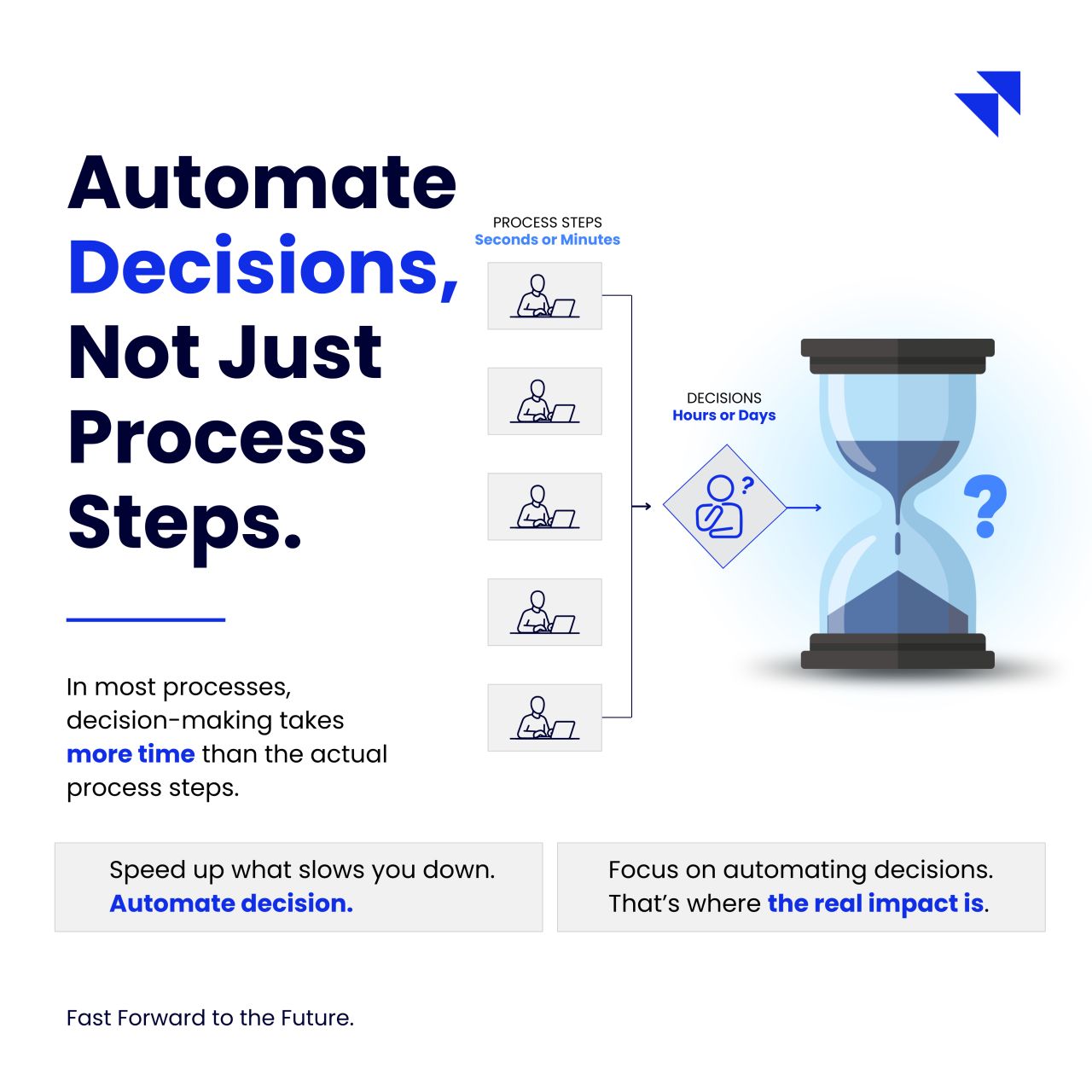
Not all decisions are equal. Some are simple and can be automated using predefined rules, while others require more advanced technologies like artificial intelligence.
The key to success is not to use AI everywhere, but where it brings real value. Simple decisions do not require complex solutions, while more complex processes can benefit from intelligent automation and data analysis.
Every decision in the organization already has a certain pattern. The only question is whether you have taken the time to recognize and optimize it, or whether you are still spending time on activities that can be automated long ago.
What decision in your organization could you automate today?
(c) 2025 Simplify. All Rights Reserved | Privacy Policy | Terms of Use